
Imagine education that fits like a tailor-made suit: courses matched to your pace, support arriving before you fail a test, and teachers who know which materials actually work. This is not science fiction – it is what learning analytics already makes possible. And as universities across Europe and Asia digitalise their teaching, the data needed for it is already there. The question is whether we use it.
pl.freepik.com
What is learning analytics?
Learning analytics is a dynamically developing field that collects and analyses data about the teaching and learning process in order to support students and improve the effectiveness of education. Every time students log in to an e-learning platform, watch a lecture recording, attempt a quiz or hand in an assignment, they leave digital traces. Analysed responsibly, these traces answer questions that used to be a matter of guesswork:
- Which students are losing drive – weeks before it shows up in their grades?
- Which materials are engaging, and which are quietly skipped?
- Do students who use interactive resources really achieve better results?
- Where in a course do most learners get stuck?
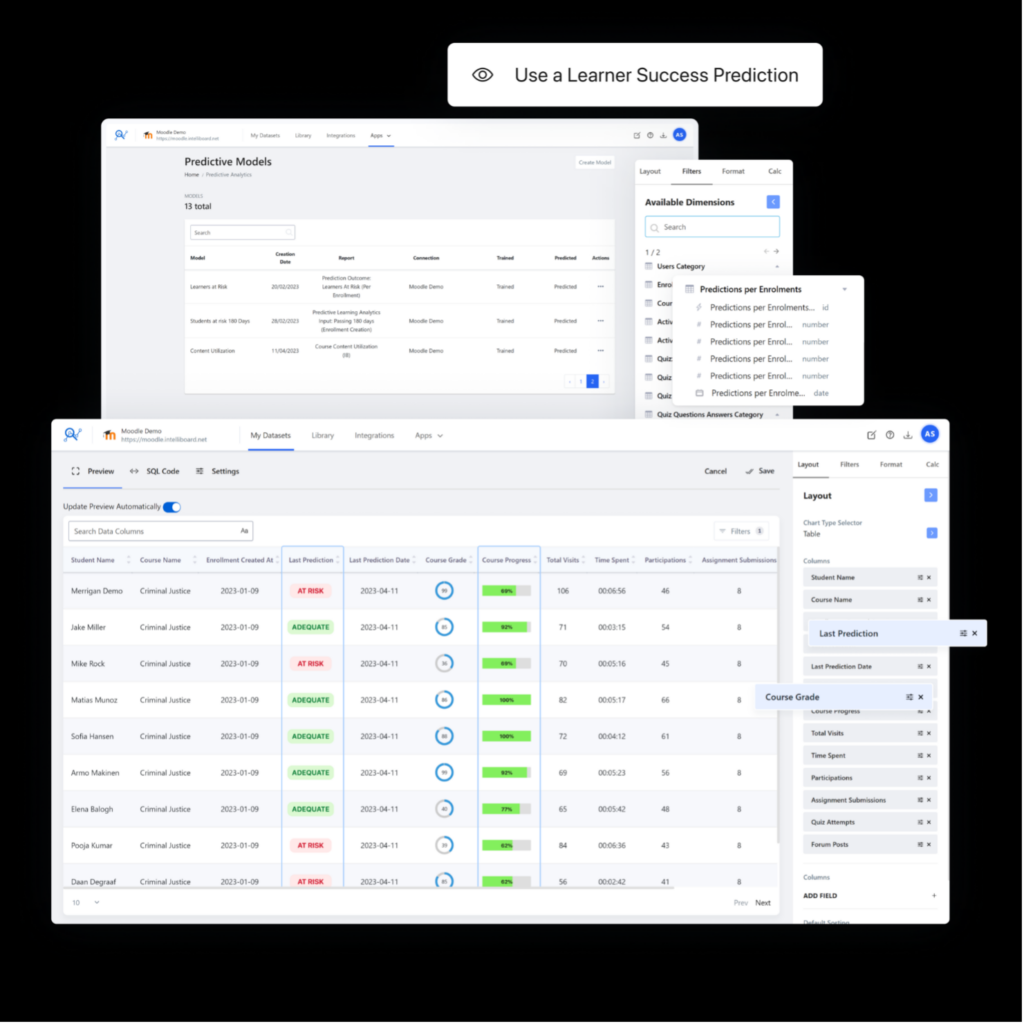
Figure 1. An example of an analytics module that can be used on the Moodle platform.
Source: https://moodle.org/plugins/local_intelliboard
At the University of Information Technology and Management in Rzeszów (UITM) we work with data from platforms such as Moodle and Webex, monitoring attendance, activity and test results. The next step is an integrated analytical platform with AI-supported dashboards for teachers and programme managers.
A simple example shows the difference this makes. A student who has not logged in for two weeks and skipped two quizzes is, statistically, on a path towards dropping out. Without analytics, the university finds out at the exam session – when it is too late. With analytics, a tutor gets a signal in week three and can simply ask: how can we help? Often a short conversation, an alternative material or a deadline adjustment is all it takes.
Why should universities care?
The value of learning analytics goes far beyond curiosity. It means better teaching quality (evidence of what works instead of opinions), early support for struggling students (intervention before a failed exam, not after), personalisation (content and pace adapted to real behaviour), and smarter management(programme-level decisions and KPI reporting based on facts). There is also a sustainability angle: a university that understands its own data wastes fewer resources – human and material – on solutions that do not work. Data-driven decision-making is simply part of a responsible, efficient institution.
Not so fast: the challenges
Learning analytics is no magic wand. Three challenges deserve honest attention. First, data quality – conclusions are only as good as the data behind them, and integrating sources across systems is hard work. Second, privacy – student data must be processed transparently and in line with GDPR; analytics should empower learners, never surveil them. Third, organisational culture – for many teachers, decisions based on dashboards rather than intuition are a genuine change, and change needs support, not decrees. Institutions that skip these questions end up with impressive dashboards nobody trusts – or uses.
Learning analytics meets MOOCs
This topic is especially close to the GreenTech Horizons project, because we have built two MOOCs – Green Entrepreneurship and Innovation and Digital Literacy & Transformation for Sustainability – for learners in the Neighbourhood East, Central Asia and Asia. In open online courses, analytics is not an add-on; it is the main feedback channel. Completion funnels, quiz statistics and activity patterns tell course creators what to improve in the next edition.
And the competence works both ways: one module of the digital literacy course, Data Analytics and Visualization for Sustainable Decision-Making, teaches exactly this skill – turning raw data into decisions that serve people and the planet.
A compass, not a crystal ball
Learning analytics will not replace teachers, and it will not predict the future with certainty. What it offers is a compass: an evidence-based sense of direction in a world where education is increasingly digital. Universities that learn to read their own data will teach better, react faster and waste less.
What could your institution learn from the data it already has? Explore the GreenTech Horizons courses at https://greentech-horizons.com/ and see how data literacy and sustainability can be taught together.
#GreenTechHorizons #LearningAnalytics #DigitalTransformation #HigherEducation #MOOC #DataDriven #ErasmusPlus