
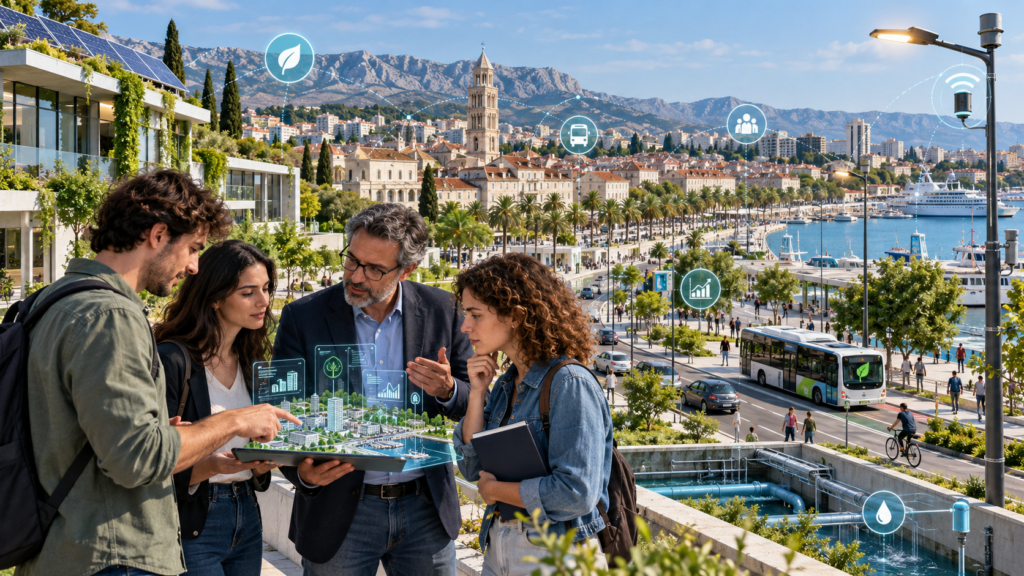
Cities are adding sensors, digital platforms and artificial intelligence to manage transport, energy, public services and infrastructure. These tools can support sustainability, but a city does not become sustainable simply because it collects more data. People must understand the technology, define useful goals and make decisions that serve residents.
For universities, this creates a clear educational challenge. Graduates need technical knowledge, environmental awareness, business skills and an understanding of public responsibility. Smart-city education must connect these competencies instead of teaching them in isolation.
Technology must solve a defined problem
A smart-city project should begin with a public need. The problem may be unnecessary energy use in municipal buildings, traffic congestion, water losses or slow maintenance of public infrastructure. Only then should a team decide which data and technologies are useful.
Without that sequence, cities risk investing in equipment that produces large volumes of data without improving services. Students should therefore learn to define the problem, identify affected users and establish measurable outcomes before selecting a sensor, platform or AI model. A successful project might aim to reduce response time for infrastructure faults or lower energy consumption while maintaining service quality.
Smart infrastructure needs several kinds of expertise
Digital competence is essential. Teams need people who can work with sensors, networks, cloud services, cybersecurity, data analytics and AI. Green competence is equally important because teams must understand energy and resource use, climate risks and the environmental effects of proposed solutions.
Business and organizational competence connects the plan with implementation. Projects require budgeting, procurement, project management, regulatory knowledge and cooperation between public institutions and companies. Communication also matters. Residents need to understand what data are collected, how decisions are made and how a new system benefits them.
A local example from the University of Split
The Smartnet AI project provides a relevant example. The University Department of Professional Studies at the University of Split participates in a partnership developing solutions for integrated smart-city e-infrastructure management. The project connects AI and machine learning with infrastructure efficiency, security, regulatory compliance and sustainable communities.
Such projects can become valuable learning environments. Students can analyse a real infrastructure challenge, discuss cybersecurity and privacy, examine sustainability indicators or propose ways to communicate a digital service to citizens. This helps them see why smart-city work rarely belongs to one discipline.
The local setting also makes learning easier to connect with daily life. Students can observe how residents use transport, public buildings and digital services, then compare those observations with available data. A small field assignment can reveal needs that are invisible in a technical specification and show why users should be involved before a system is designed. This practice also develops communication skills.
A question for readers
Smart cities depend on people who can connect technology with sustainability and public value. Universities can prepare them through interdisciplinary courses, practical projects and cooperation with local authorities and industry.
Which problem in your city could benefit from a digital solution, and what competencies would a team need to solve it responsibly? Follow GreenTech Horizons for more examples of education for the green and digital transition.
#GreenTechHorizons #SmartCities #Sustainability #HigherEducation