
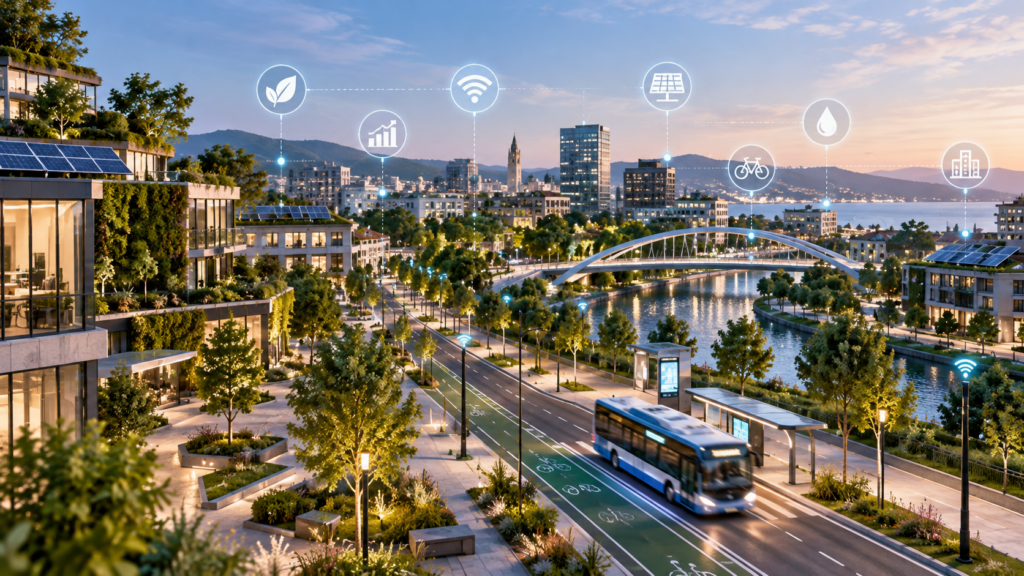
Imagine arriving at university on a rainy morning. Your bus adjusts its route because sensors have detected congestion. Streetlights reduce their energy use when no one is nearby. A mobile application tells you which cycling route has the cleanest air. Buildings automatically respond to changing energy demand, while city planners use a digital model to test what would happen if more solar panels, green spaces or electric vehicles were introduced.
This is the idea behind the smart city. But the most important word may not be smart. It may be city.
Cities are complex environments where people, buildings, transport, energy, technology, nature and public services interact. Making them more sustainable therefore requires much more than installing sensors or developing another app. Smart urban development combines digital technology with environmental innovation, good planning and meaningful participation by the people who actually use the city.
The Green Tech Horizon learning materials highlight technologies including the Internet of Things (IoT), artificial intelligence, digital twins, Geographic Information Systems (GIS), smart grids and predictive modelling. They can help cities monitor traffic, energy use, air quality and water levels, test future scenarios and make better-informed decisions.
Why does this matter now?
Because the way cities develop during the next few years will influence how successfully societies respond to climate change, energy pressures, mobility challenges and growing demand for resources.
This creates an important opportunity for students.
The urban transition needs people who can understand several worlds at once. Engineers need to understand sustainability. Urban planners increasingly need to understand data. IT specialists need to think about energy, mobility, privacy and cybersecurity. Environmental specialists need digital skills. Economists need to evaluate long-term social and environmental benefits alongside financial costs.
In other words, the smart city is a multidisciplinary classroom at city scale.
From classroom exercise to real urban problem
Consider traffic congestion. A traditional response might be to build another road. A smart-city approach asks a wider set of questions.
Where and when does congestion occur? Could IoT sensors provide better evidence? Could GIS reveal relationships between congestion, residential areas and public transport? Could an AI model forecast tomorrow’s peak period? What would happen if traffic lights responded dynamically? Would better cycling infrastructure change travel behaviour? Would the solution reduce emissions—or simply move congestion elsewhere?
The Green Tech Horizon modules encourage exactly this kind of thinking. Students are asked to collect or simulate sensor data, map energy and pollution hotspots, develop simplified digital twins and use predictive analytics to examine energy demand and traffic conditions.
That matters because tomorrow’s professionals will increasingly be expected not only to operate digital tools but also to question the assumptions behind them.
Data are not automatically neutral. A sensor network can miss neighbourhoods. An algorithm can optimize travel time without considering accessibility. A technically efficient solution can be too expensive for some residents. Collecting urban data can also raise questions about privacy and cybersecurity.
Smart-city systems therefore need scalability, interoperability, resilience and security, but technological performance alone is not enough. The course materials also emphasize stakeholder engagement and participatory governance as central components of modern urban planning.
Green innovation makes the challenge even more interesting
Smart cities become particularly powerful when digital innovation and green innovation meet.
A digital twin can simulate energy use before a district is renovated. Smart grids can coordinate renewable energy and storage. Sensors can identify water leakage or pollution. Green infrastructure can reduce urban heat and manage heavy rainfall. Mobility platforms can help connect walking, cycling and public transport.
The objective is not simply a more automated city. It is a city that uses resources more intelligently while becoming healthier, more resilient and more inclusive.
For students, that means smart-city knowledge is relevant across a remarkably broad range of future careers—from civil engineering and architecture to environmental science, energy, data analytics, public administration and entrepreneurship.
So here is the question worth carrying into your studies:
If you were given the data, digital tools and opportunity to redesign one part of your city, what problem would you solve—and how would you make sure your solution was not only smart, but genuinely sustainable and useful to the people who live there?
The future city will not be designed by technology alone. It will be shaped by people who know how to connect technology with evidence, sustainability and human needs.
Students studying these connections today may be among the people making those decisions tomorrow.