
There are about 3.7 billion gamers in the world – nearly half of humanity – and the global games market reached 184 billion dollars in 2023. Meanwhile, universities still struggle to make sustainability more than a chapter in a textbook. What if the engagement that keeps people playing could be used to teach the competences the planet urgently needs? That question sits at the heart of game-based learning (GBL) – and of our recent research.
Why lectures are not enough anymore
Generations Z and Alpha grew up with technology in their hands. Research consistently shows they prefer interactive, collaborative and adaptive learning, and lose attention quickly in passive formats. At the same time, the key sustainability competencies – systems thinking, anticipatory thinking, values-based decision-making, strategic action, collaboration – share an awkward feature: they cannot simply be taught; they have to be developed by learners themselves, through experience. A lecture can describe a trade-off between profit and planet. Only practice lets you feel it.
Meet SEED: running a café with a conscience
In the SEED simulation game, developed in an EU-funded project, student teams become the executive board of “The Café”. They make the decisions every real business faces: location, interior design, equipment, suppliers, staff, marketing, prices. The twist is that every decision has a sustainability dimension. Do you choose the cheaper equipment or the energy-efficient one? The supplier with the lowest price or the one with responsible practices? Do you invest in an interior accessible to customers with disabilities? Do you hire inclusively?
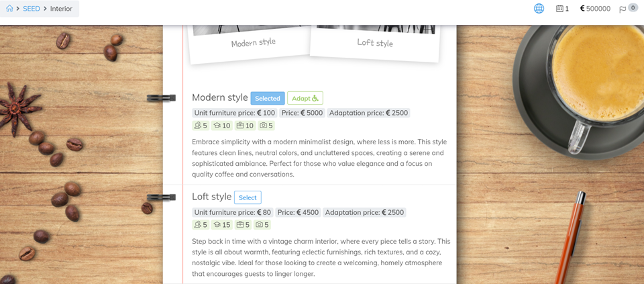
Figure 1 Example of SEED Game Interface: Customizing Café Location and Design (illustrating Ownership & Possession drive).
The game keeps score in three parallel ways:
- Overall ranking – classic business performance, driven by revenue;
- Ecological ranking – how sustainable your equipment, suppliers, marketing and waste management really are;
- CSR ranking – accessibility, inclusive employment and responsible business practices.
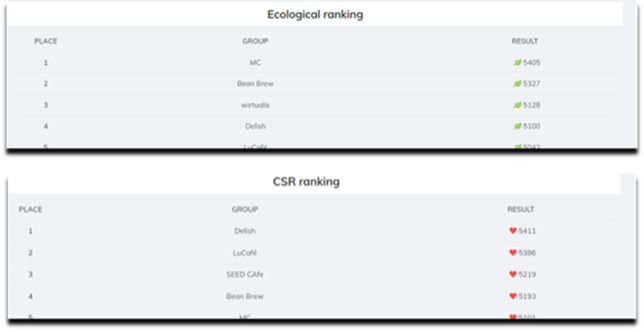
Figure 2 Example of SEED Game Feedback Screen: Rankings and Performance Indicators (illustrating Development & Accomplishment and Transparency).
The tension between the three rankings is not a bug – it is the lesson. Teams discover, sometimes painfully, that maximising short-term profit can sink their ecological standing, and that responsible choices require strategy, not just good intentions. That is systems thinking, learned by doing.
What students actually take away
Our analysis of SEED shows that a well-designed simulation develops the full spectrum of sustainability competencies described in international frameworks – from critical thinking and collaboration to integrated problem-solving – while touching concrete Sustainable Development Goals: quality education (SDG 4), decent work (SDG 8), innovation (SDG 9), reduced inequalities (SDG 10) and sustainable communities (SDG 11). Just as important, students can experiment and fail safely: bankrupting a virtual café teaches more than passing a test, and costs nothing.
This is consistent with a broad body of research on game-based learning. Studies point to higher motivation, attention and engagement, immediate feedback that works as continuous formative assessment, space for trial-and-error learning, and better transfer of skills to real situations. Games also naturally support collaboration – a competence employers name among the most wanted, and one that traditional exams hardly measure at all.
From games to MOOCs – the GreenTech Horizons way
The same philosophy – learning by doing, prototyping, testing – runs through the GreenTech Horizons MOOC Green Entrepreneurship and Innovation: participants design value for people and planet, build sustainable business models, prototype and test green solutions, and finally pitch their green ventures to stakeholders. The Digital Literacy & Transformation for Sustainability course adds Innovation Labs, where learners design sustainable digital solutions. Education for the twin transition works best when it feels less like listening – and more like playing for real stakes.
Ready to press start?
Game-based learning is not about making education entertaining; it is about making it experiential. If we want graduates who can balance profit, people and planet, we should let them practise – in safe, simulated worlds first.
How could your course, company training or classroom use a game to teach sustainability? Explore GreenTech Horizons at https://greentech-horizons.com/ – and read the full research article for the evidence behind this post.
#GreenTechHorizons #GameBasedLearning #Sustainability #SDGs #HigherEducation #GreenEntrepreneurship #ErasmusPlus