
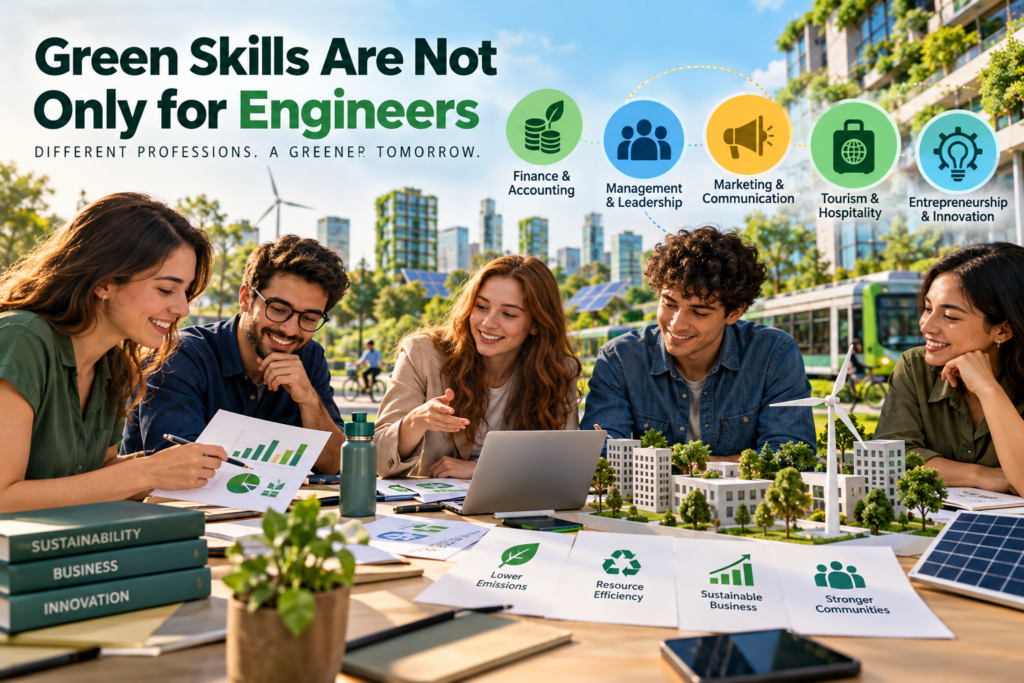
Solar power, energy-efficient buildings and electric mobility make the green transition look like an engineering project. Engineers are essential, but technical solutions alone cannot change how organizations invest, purchase, produce, communicate and measure results. Accountants, managers, tourism professionals, marketers and entrepreneurs all make decisions with environmental consequences.
Higher education should therefore treat green competence as part of many professions. Students do not all need the same technical depth, but they do need enough knowledge to recognize environmental effects and include them in their work.
Finance and accounting shape environmental decisions
Investment decisions determine whether organizations adopt efficient equipment, renewable energy or circular production. Finance professionals need to compare initial costs with energy savings, maintenance, risks and the useful life of an investment. Accountants increasingly work with sustainability information alongside financial data.
Students in these fields can practise evaluating a building renovation, estimating the return of an efficiency measure or selecting indicators for sustainability reporting. They should also learn to question weak claims. A product described as green may shift impacts to another stage of its life cycle or rely on incomplete data.
Importance of managers
A sustainability goal has little effect if it is not connected with responsibilities, budgets and processes. Managers coordinate people, suppliers and projects. They need to set measurable objectives, manage change and evaluate trade-offs between cost, service quality and environmental performance.
A useful classroom case might ask students to reduce energy and waste in a hotel, university or small manufacturing company. The task requires more than a list of technologies. Students must decide who is responsible, what data are needed, how progress will be tracked and how employees and users will participate.
Marketing and tourism require credible communication
Customers increasingly come across environmental labels, carbon claims and promises of sustainable experiences. Communication professionals need enough sustainability knowledge to distinguish evidence from vague promotion (greenwashing). Misleading claims can damage trust and expose an organization to regulatory and reputational risks.
Tourism professionals face practical questions about water and energy use, waste, mobility and pressure on local communities. They need to design services that remain attractive while respecting local resources. Digital tools can support booking, monitoring and visitor information, but professionals must decide which outcomes matter.
Every profession needs a relevant version of green competence
Green competence should be taught through the decisions graduates will actually make. Engineering students may calculate energy performance. Accounting students may evaluate environmental costs. Management students may design an implementation plan. Tourism students may propose ways to reduce seasonal pressure or resource use.
Interdisciplinary projects allow these perspectives to meet. A team can develop a solution, estimate costs, assess environmental effects and explain it to users. This looks like real work more closely than treating sustainability as a separate topic owned by one department.
Professional development for teachers is part of the solution. A lecturer does not need to become an environmental specialist overnight, but may need examples, shared teaching materials and a colleague from another discipline. Short joint modules can introduce sustainability within an existing course without requiring a complete programme redesign. They can also grow gradually through feedback.
A question for readers
The green transition will succeed or fail through thousands of decisions made across occupations. Universities can prepare students by linking sustainability to professional tasks, evidence and responsibility. That approach also shows employers what a graduate can contribute from the first day of work.
What environmental decision might someone in your profession make, and which skill would help them make it better? Explore GreenTech Horizons to see how green, digital and business competencies can be combined in higher education.
#GreenTechHorizons #GreenSkills #Sustainability #HigherEducation