
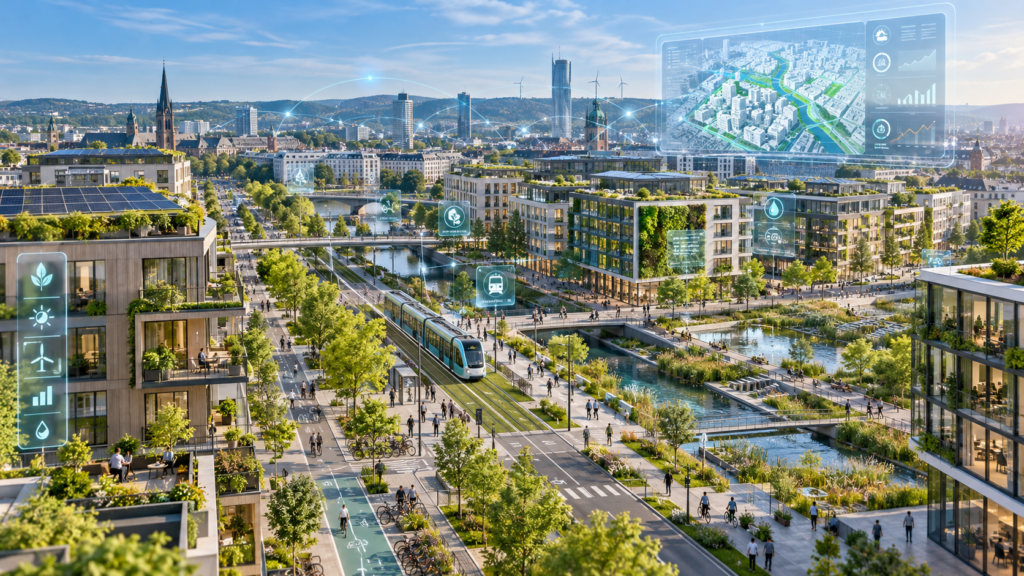
The smart-city research agenda is undergoing an important transition. The central question is no longer simply whether artificial intelligence, IoT sensors, digital twins or advanced data platforms can improve urban services. Increasingly, the challenge is to determine how these technologies interact with energy systems, spatial planning, governance, citizen behaviour, climate adaptation and existing infrastructure—and whether those interactions produce measurable public value.
This makes smart cities and urban green innovation a particularly fertile field for interdisciplinary research.
The Green Tech Horizon materials frame contemporary urban planning as a combination of long-term strategic vision and real-time operational management. Macro-level modelling can support demographic and infrastructure forecasting over 20–30-year horizons, while digital twins, GIS, IoT and socio-economic datasets increasingly enable more dynamic monitoring, simulation and predictive analysis.
At the same time, sustainable urban development requires energy efficiency, climate adaptation, resource optimization, resilience and social inclusion. The research challenge therefore lies in connecting the digital and green transitions rather than investigating them as parallel processes.
Why does this matter now?
European urban policy is moving rapidly from experimentation towards implementation.
The EU Mission on Climate-Neutral and Smart Cities is supporting 112 cities pursuing climate neutrality by 2030, with participating cities expected to function as experimentation and innovation hubs that generate lessons for wider replication. Climate City Contracts link plans for energy, buildings, transport and waste with investment strategies and stakeholder participation.
For researchers, this represents more than a policy initiative. It creates an unusually rich environment for studying systemic urban transformation.
The opportunity is particularly visible in the 2026 Horizon Europe Cities Mission agenda. A current call includes research and innovation topics covering energy-efficient urban and suburban public transport, transition to low-temperature heating in multi-apartment buildings, AI-based urban planning and management, and circular-economy approaches to construction at building and city scale.
These priorities illustrate an important shift. Smart-city research is increasingly expected to connect technological performance with decarbonization, infrastructure investment, governance and implementation.
The problem of integration
One of the persistent difficulties is that cities consist of interacting systems rather than isolated technical domains.
Optimizing an energy network may influence mobility, building demand and electricity-market behaviour. Expanding electric mobility affects charging infrastructure and peak loads. Urban greening can affect temperature, stormwater management, biodiversity and public health. Transport interventions alter accessibility, land use and social behaviour.
Digital twins offer a promising way to investigate these interactions because they can integrate physical assets, processes and data into models capable of scenario testing. The European Commission is developing a Local Digital Twins Toolbox based around reusable tools, reference architectures, open standards and technical specifications, including AI-enabled approaches for testing impacts on areas such as traffic, pollution and public health.
Yet sophisticated modelling introduces its own research questions.
What constitutes sufficient data quality? How should uncertainty be communicated? How transferable is a model between cities? How should heterogeneous datasets be made interoperable? Who owns and governs urban data? How should privacy, cybersecurity and algorithmic accountability be incorporated?
The Green Tech Horizon materials similarly identify scalability, interoperability, resilience and security as core architectural requirements for smart urban systems.
Beyond technological optimisation
Perhaps the more fundamental research opportunity concerns the definition of urban performance itself.
A system can become more energy-efficient without becoming more equitable. A mobility algorithm can reduce average journey time while worsening accessibility for specific communities. A sensor-rich city may generate extensive data while failing to translate those data into better decisions.
This is why communicative planning and participatory governance are as relevant to smart cities as predictive models. The Green Tech Horizon framework explicitly brings stakeholder engagement together with rational, data-driven planning, sustainability and digital integration.
The European Commission similarly describes successful urban transformation as requiring cooperation among local authorities, citizens, businesses, investors and national and regional institutions.
This creates space for research connecting engineering, computer science and environmental modelling with economics, sociology, governance, behavioural science, design and ethics.
It also strengthens the case for urban living labs, where researchers can move beyond controlled experimentation and examine technology within the institutional and social environments in which it must operate.
What should we measure?
The Green Tech Horizon study programs modules propose indicators including energy savings, renewable-energy penetration, smart-grid coverage, emission reductions and technology cost-benefit ratios.
Those indicators are essential—but the research frontier increasingly asks whether we should measure more: accessibility, affordability, health, resilience, biodiversity, public acceptance, distributional effects and the capacity of solutions to scale.
The critical research question may therefore be:
How can we design and evaluate smart urban systems so that digital innovation produces demonstrable environmental and social outcomes rather than technological sophistication alone?
Answering it will require more than better algorithms. It requires shared methods, interoperable data, longitudinal evaluation, interdisciplinary research and deeper collaboration between universities, municipalities, industry and citizens.
That intersection is precisely where urban green innovation can make its greatest contribution