
How should universities prepare students for a future in which sustainability challenges are increasingly addressed through data, artificial intelligence, digital platforms and interconnected technologies?
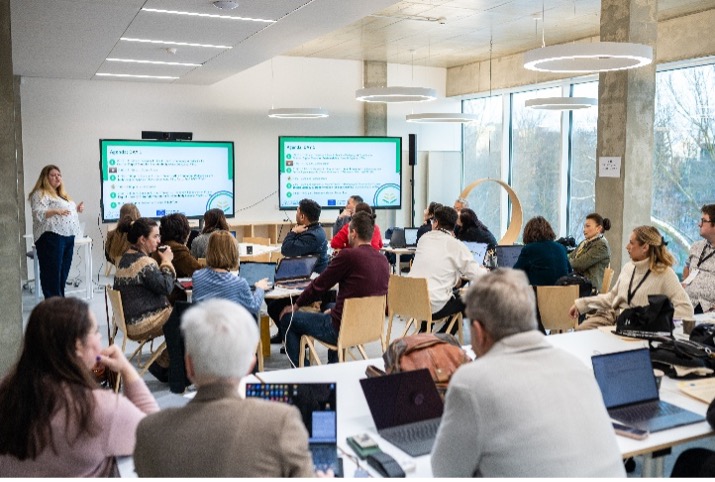
This question was at the heart of the 2nd Train-the-Teachers Workshop of the GreenTech Horizons project, organised as part of the joint training school held in January 2026 at Kaunas University of Technology (KTU) and Riga Technical University. The training brought together more than 40 professors, lecturers, researchers and other academic staff from universities across the European Union, the Neighbourhood East, Central Asia and Asia. 2ns Train-the-Teachers Report 2ns Train-the-Teachers Report
The purpose went beyond introducing new technologies. The workshop focused on a more demanding challenge: how to teach the green and digital transitions in ways that are practical, interdisciplinary, critical and relevant to students’ future professional lives.
That challenge matters increasingly today. Sustainability problems are becoming inseparable from digitalisation. Cities use sensors to monitor pollution and traffic. Energy systems increasingly depend on smart grids, predictive analytics and distributed renewable generation. Environmental specialists work with geospatial data, dashboards and remote sensing. Artificial intelligence is entering research, professional practice and education itself.
For students, this means that disciplinary knowledge alone may no longer be sufficient. Future professionals will need combinations of technical competence, data literacy, systems thinking, ethical reasoning and the ability to evaluate trade-offs.
For university teachers, the implication is equally significant: teaching must evolve alongside the technologies and societal challenges students are expected to address.
Teaching the twin transition, not two separate transitions
The Kaunas programme reflected the GreenTech Horizons project’s broader objective of strengthening universities’ capacity to design and deliver high-quality courses addressing both green and digital transformation. The training therefore combined sustainability-oriented content with pedagogical methods, AI tools, digital technologies and learner-centred approaches. One major theme was Digital Tools for Sustainability.
Participants explored how open-data platforms, visualisation systems, GIS, remote sensing, life-cycle assessment tools, AI-supported analytics and collaborative digital environments can become part of sustainability education. Examples discussed during the workshop included QGIS, ArcGIS Online, Google Earth Engine, Power BI, Tableau and life-cycle assessment tools such as OpenLCA. Yet an important message emerged: more data do not automatically produce better decisions.
In a practical exercise, participants worked with sustainability topics such as CO₂ emissions, renewable energy, waste and air quality, created visualisations and then examined the limitations of the underlying data. The exercise prompted discussion about aggregation, interpretation, uncertainty and the ethical responsibility involved in presenting environmental information.
For researchers and students alike, this is highly relevant. Sustainability dashboards can appear authoritative while hiding methodological limitations. AI can identify patterns while still producing incorrect or poorly contextualised outputs. A visually persuasive graph can simplify a complex reality too far.
AI changes the role of the teacher
Artificial intelligence in education was another important strand of the workshop. Participants explored AI-supported tutoring and the possibility of developing agents that interact with learners through dialogue, adapt explanations and support self-regulated learning. The workshop framed these tools as potential responses to challenges such as differences in students’ prior knowledge and declining engagement with traditional learning materials.
For higher education, AI literacy therefore cannot simply mean teaching students how to write better prompts. It involves understanding reliability, bias, responsibility, appropriate use and the consequences of delegating decisions to automated systems.
From lectures to learning through decisions
A recurring theme throughout the Kaunas training was the move from knowledge transmission toward active and experiential learning. Participants discussed case-based teaching, project work, simulations, microlearning and competency-based education. One particularly tangible example was the “NOrisk” table-top game, in which participants analysed realistic cybersecurity incidents, assessed threats and vulnerabilities, evaluated risk and selected appropriate risk-management strategies.
These matters because the infrastructure behind smart and sustainable societies is becoming increasingly interconnected. A cyber incident affecting a smart grid, environmental monitoring platform or mobility system can have consequences that extend beyond information technology into sustainability, service continuity and public trust. Education therefore needs to help students connect technical decisions with wider environmental, economic and social consequences.
The workshop also demonstrated this principle through sustainable-energy teaching. Participants explored energy systems not as isolated technologies but as socio-technical systems shaped by engineering, economics, regulation and human behaviour. Teaching scenarios required learners to balance sustainability, affordability, security and technical feasibility rather than search for a single “correct” solution. 2ns Train-the-Teachers Report
Why this matters for GreenTech Horizons
The Kaunas workshop demonstrated an important principle for the GreenTech Horizons project: successful green and digital transitions depend not only on technological innovation but also on educational capacity. Today’s students will become tomorrow’s engineers, researchers, planners, entrepreneurs and decision-makers. Their professional environments will increasingly require them to work across disciplinary boundaries and to judge competing technological, environmental and societal priorities.
Teachers therefore act as multipliers. The participants in the training were not only learners; they were expected to adapt the approaches and course content within their own institutions. 2ns Train-the-Teachers Report
The question emerging from the Kaunas workshop is consequently larger than how universities should incorporate another digital platform or sustainability module:
How can higher education equip students not merely to use emerging technologies, but to decide when, why and how those technologies should contribute to sustainable transformation?
The GreenTech Horizons training suggests that the answer begins with educators themselves—through experimentation, collaboration, critical digital literacy and teaching that allows students to confront the complexity of real-world decisions.