
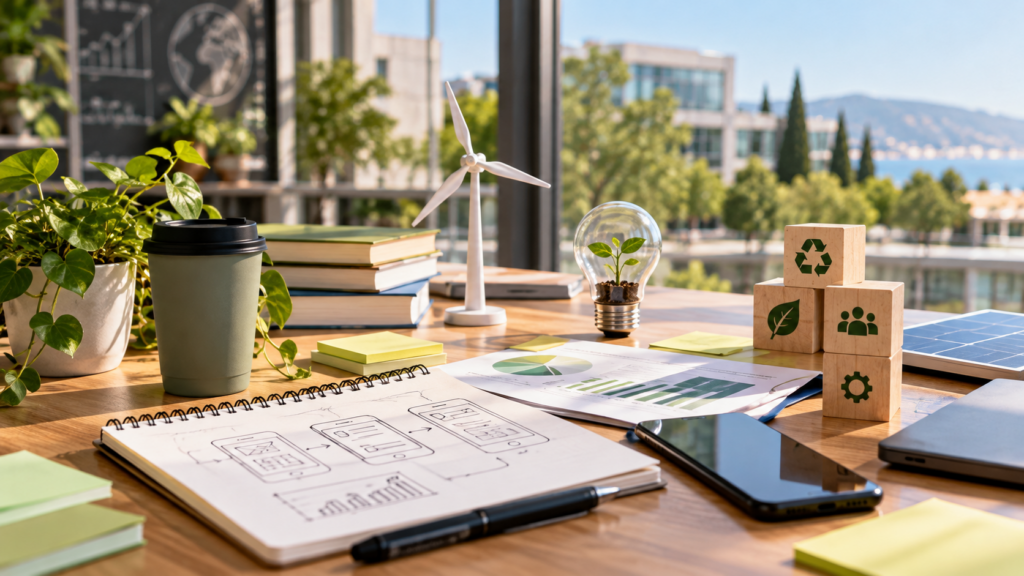
An app that helps people share equipment sounds like a promising green business idea. But a working app does not, by itself, show that people need the service, that it can keep operating or that it will reduce resource use. For students exploring green entrepreneurship, the challenge is to test those assumptions before treating the technology as the solution. Where should that testing begin?
Find the problem behind the idea
Start with a particular group of people and a situation they already face.
For an illustrative equipment-sharing service, potential users might be students who occasionally need tools for practical projects. Before designing features, ask how they currently obtain the equipment, what causes difficulty and what makes them reluctant to borrow or lend.
A general question such as “Would you use a sustainable sharing app?” invites a general answer. Questions about a recent experience can reveal something more concrete.
What equipment did they need? How did they obtain it? Was availability, reliability, access or uncertainty the main difficulty?
Listen for differences rather than trying to confirm the original idea. A group that can borrow equipment easily may not need another platform. Another group may need clearer information about existing services rather than a new service altogether.
The first useful result could be a revised problem statement—not a prototype.
Test the environmental promise separately
Next, specify what environmental improvement the idea is intended to support.
In the sharing example, the team might hope that access to existing equipment would avoid some additional purchases. That is a hypothesis to investigate, not an outcome to announce.
Ask what would happen without the proposed service. Would users buy something new, borrow elsewhere or decide not to carry out the activity? The answer affects how the team should think about possible benefits.
Also ask what additional activity the service would involve: transporting items, maintaining them, replacing damaged equipment or supporting the digital system. Identify these questions without claiming that you have already calculated the overall environmental effect.
A useful working statement is: “We expect this service to support this improvement, provided these conditions hold. We would need this evidence to test that expectation.”
That is more informative than describing the idea as “eco-friendly” before examining how it would actually work.
Explore how the service could keep running
Now consider the practical model behind the idea.
Someone would need to maintain the inventory, respond to users, manage availability and deal with problems. Clarify who might take responsibility and what resources the service would require.
Keep the user and the supporting organisation in view. A service could be free to students while still requiring time, equipment and ongoing support from a university or another organisation. Free access does not remove those responsibilities.
Before developing an app, the team could test the basic process through a small, supervised trial using existing tools. The purpose would be to learn whether people can find, request and return suitable items—and where the process becomes difficult.
Define what the trial can and cannot establish. A small test might reveal confusing instructions, but it would not prove long-term demand or overall environmental benefit.
Choose the next step according to what remains uncertain, not according to which feature is most exciting to build.
Treat the assumptions as learning material
This example brings green, digital and business thinking into the same activity. Learners must examine an environmental purpose, consider whether a digital tool is useful and explain how the proposed service would operate.
GreenTech Horizons’ project design connects green entrepreneurship and innovation with competency-oriented learning. Its second work package (WP2) brings identified needs into educational design, rather than treating subject content as an isolated starting point.
For an educator, a suitable assignment could therefore be an assumption test rather than a conventional business pitch. Ask learners to identify the people affected, investigate one uncertainty and explain what the evidence changed.
For us at European Academy, a useful question is whether learners can distinguish a promising idea from a supported conclusion. A carefully explained decision to change direction can demonstrate as much thoughtful learning as a decision to continue.
Start with the uncertainty that matters most
A green business idea becomes more credible when its purpose, demand and practical conditions are examined together. Technology should serve that investigation, not replace it.
Take an idea you are considering and complete this sentence: “This would work only if…” Choose one important assumption and design a small, appropriate way to investigate it. What would you need to learn before building the app?
Hashtags: #GreenTechHorizons #EuropeanAcademy #GreenEntrepreneurship #SustainableInnovation