
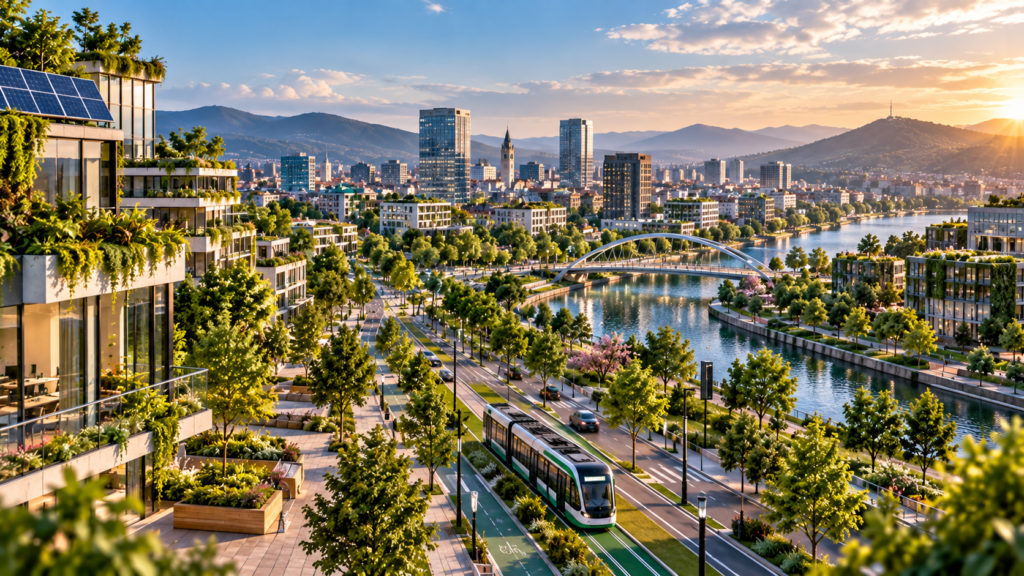
When people hear the expression “smart city,” they may imagine futuristic buildings, autonomous vehicles and streets filled with sensors. Some of that technology is already becoming part of urban life. But a genuinely smart city is not simply a city with more technology.
It is a city that uses knowledge, technology and nature to solve everyday problems: reducing wasted energy, making transport easier, improving air quality, preparing for heatwaves and floods, creating healthier neighbourhoods and delivering public services more efficiently. Most importantly, it is a city designed around the people who live there.
Smart cities and urban green innovation bring together two transformations that are often discussed separately. The digital transition gives cities new tools for understanding what is happening around them. The green transition asks how cities can reduce environmental impacts while remaining comfortable, affordable and resilient.
Increasingly, the two belong together.
Why does this matter now?
Climate change is already affecting European cities, and adaptation is becoming an immediate urban challenge rather than a distant objective.
The European Environment Agency notes that climate-related hazards such as floods and droughts are expected to become more frequent or intense in many regions. For cities, adaptation can involve increasing green space, creating rain gardens, providing shade through trees, changing building requirements and introducing nature-based flood protection.
At the same time, cities must reduce emissions from buildings, energy and transport.
This is why the European Union has established a Mission on Climate-Neutral and Smart Cities. It currently supports 112 European cities working towards climate neutrality by 2030 and aims to turn them into experimentation hubs whose successful approaches can be used elsewhere.
The important point is that “smart” and “green” are increasingly being treated as parts of the same urban transformation.
What does that look like in everyday life?
Imagine a street during a summer heatwave.
A traditional approach might focus on providing more air conditioning. A green and smart approach could start much earlier. Satellite information and street-level sensors could identify the hottest neighbourhoods. City planners could use digital maps to locate areas lacking trees and shade. A computer model could simulate how different combinations of trees, green roofs and building materials would affect temperature.
The final solution might be surprisingly low-tech: plant more trees.
The intelligence comes from knowing where intervention will make the greatest difference.
The same idea applies to transport. Sensors can reveal where traffic repeatedly builds up. Data can help coordinate public transport. Dynamic traffic management may reduce unnecessary waiting and fuel consumption. Better information can also make walking, cycling and shared transport easier.
Energy provides another example. Smart meters can help monitor consumption, while smart electricity grids make it easier to coordinate renewable energy and storage. The Green Tech Horizon materials describe how combinations of smart metering, renewable generation and energy storage can contribute to more efficient and resilient urban infrastructure.
Waste, water and air quality can also be monitored more precisely, allowing cities to respond earlier rather than waiting until problems become severe.
A virtual city before changing the real one
One particularly interesting development is the digital twin.
A digital twin is a virtual representation of part of a city. It can combine information from maps, buildings, transport systems and sensors so that planners can test possible changes before implementing them.
For example: What happens to congestion if a road is redesigned? How could a new tram line change travel pattern? What happens to electricity demand if electric-vehicle use rises? Which neighbourhood would benefit most from green infrastructure?
The European Commission is developing tools that will allow cities of different sizes to use local digital twins to explore scenarios involving issues such as traffic, pollution, emergencies and climate change.
But there is an important catch.
A city is not a computer simulation.
Who decides what a “better” city means?
Technology can tell us how quickly traffic moves. It cannot decide whether a neighbourhood should prioritize cars, buses, bicycles, pedestrians or public space.
An algorithm can optimize energy use. It cannot decide by itself whether the costs and benefits are distributed fairly.
Sensors can collect enormous quantities of information. Citizens still need assurance that data are used securely, transparently and for legitimate purposes.
This is why modern smart-city thinking increasingly emphasizes participation as well as technology. Green Tech Horizon’s urban-planning materials combine data-driven planning with stakeholder engagement and citizen-centred approaches.
The question is therefore not simply:
“How much technology should our cities have?”
A better question is:
“How can we use technology, green infrastructure and collective knowledge to make our neighbourhoods healthier, more resilient and better places to live?”
The smartest city may not be the one with the largest number of sensors or the most sophisticated artificial intelligence.
It may be the city that knows which problems technology can solve, which problems nature can solve, and which decisions should ultimately remain in the hands of people