
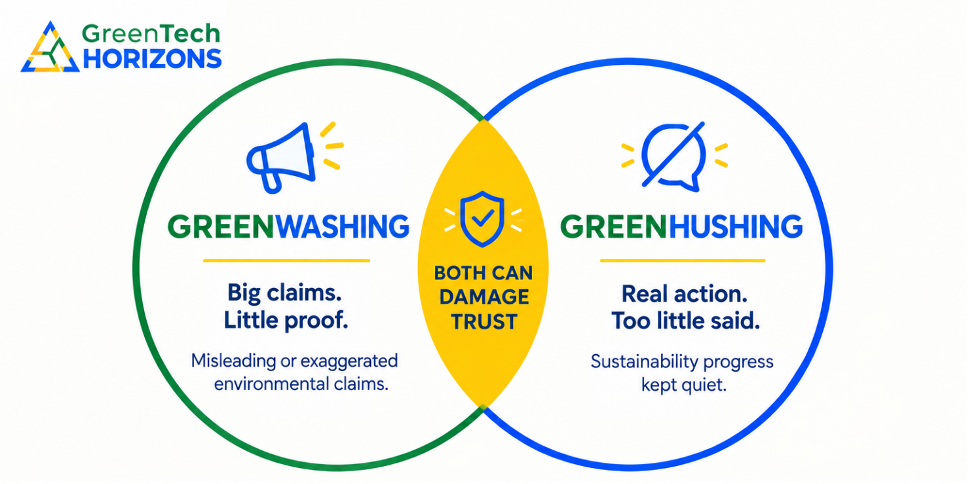
For years, the problem with green marketing was simple: companies said more than they did. Today, a growing number of companies do more than they say. Only 36% of consumers now report seeing at least some sustainability messaging from brands, down from 49% in 2023. So, is silence the new safe strategy, or simply a new kind of risk?
Meet greenhushing
Greenhushing means deliberately staying quiet about sustainability efforts, even when those efforts continue. The numbers behind the trend are striking:
- In a study of 75 global companies, 85% had maintained or expanded their sustainability programmes, but only 16% publicly reaffirmed them.
- The use of sustainability language in S&P 500 earnings calls fell by 76% over three years.
- Courts are watching closely. In 2025, a German court found Apple’s CO₂-neutral claims for the Apple Watch misleading.
The reasons are understandable: political backlash against ESG, fear of litigation and stricter rules on environmental claims. When every sentence can become a legal risk, saying nothing starts to feel reasonable.
Why silence backfires
The problem is that markets do not stop listening when companies stop talking. They simply hear less, and trust less.
GlobeScan’s survey of more than 30,000 consumers in 31 markets shows that trust in sustainability communication is falling: 65% of those who see such messages trust them at least somewhat, compared with 74% in 2023 and 79% in 2022. Less communication means less engagement, and less influence over the very behaviour that sustainability depends on.
Silence also has a business cost. Buyers, investors and future employees still ask for sustainability data. More than 80% of institutional investors see sustainability as part of risk management. A company that cannot explain its progress may simply be left out.
Europe is rewriting the conversation
In the EU, the rules of green communication have changed dramatically in 2026.
- 27 September 2026: under Directive (EU) 2024/825, vague claims such as eco-friendly or green, and product claims of climate neutrality based on carbon offsets, are no longer allowed without proof.
- 19 July 2026: large companies may no longer destroy unsold clothing and footwear. Until now, an estimated 4–9% of unsold textiles in Europe were destroyed before ever being worn, generating around 5.6 million tonnes of CO₂ a year, roughly the net emissions of Sweden in 2021.
- 18 February 2027: batteries for electric vehicles, e-bikes and industrial use will need a digital battery passport, accessible through a QR code.
The direction is clear: sustainability is moving from slogans to data.
From slogan to scan
The battery passport is the first of many Digital Product Passports planned under the EU Ecodesign for Sustainable Products Regulation. Textiles, electronics and furniture are expected to follow. A passport can show what a product is made of, how much recycled content it contains, its environmental footprint, and how it can be repaired or recycled.
For marketing, this is a quiet revolution. The most credible green message may no longer be in the advert at all, but one scan away, on the product itself. When customers can check the data in seconds, the story has to match the evidence. This is the twin green and digital transition at its most practical.
Neither washing nor hushing: five rules for green communication
- Say less, show more. One specific, measurable claim beats ten green adjectives.
- Share progress honestly. Explain what has been achieved, and what has not yet been achieved.
- Make every claim checkable. Link it to data, a recognised certification or a product passport.
- Align your teams. Marketing, product and data teams must tell the same story.
- Do not go silent. Keep talking to the stakeholders who need your data.
The real skill: credible communication
Greenwashing damages trust by saying too much. Greenhushing damages it by saying too little. The professionals the twin transition needs are those who can do both jobs well: understand the data behind sustainability and turn it into communication people can trust. This combination of green, digital and business competencies is exactly what GreenTech Horizons aims to strengthen.
So, is your organisation too loud, too quiet, or ready to be scanned?
Explore GreenTech Horizons and join the conversation on the skills that make sustainability credible.
Hashtags: #GreenTechHorizons #GreenMarketing #Greenhushing #Greenwashing #DigitalProductPassport #GreenCommunicationSkills