
What makes a city genuinely “smart”?
Is it the number of sensors installed in its streets? The sophistication of its artificial intelligence? Its digital twin? Its smart electricity grid?
Or should a smart city ultimately be judged by something more fundamental: whether technology helps create a cleaner, more resilient, efficient and inclusive place for people to live?
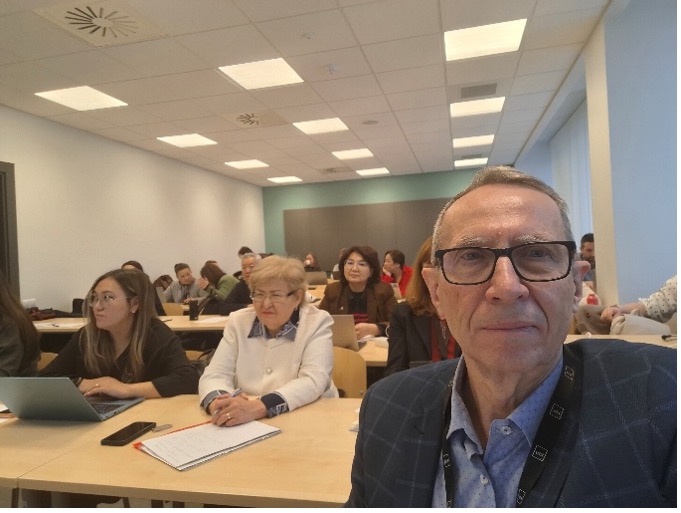
These questions shaped the Smart Cities and Urban Green Innovation workshop at Riga Technical University (RTU), part of the GreenTech Horizons joint Train-the-Teachers Training School held in January 2026. The wider training programme brought together academic staff, researchers, project coordinators and experts from partner institutions to strengthen universities’ capacity to teach the combined green and digital transition.
At RTU, this challenge became particularly concrete. The Smart Cities and Urban Green Innovation session, led by Prof. Nadežda Kuņicina and Dr. Anatolijs Zabašta, focused on how educators can translate fast-developing urban technologies and sustainability concepts into meaningful learning experiences for interdisciplinary groups of students.
Why smart-city education matters now
Cities are becoming central arenas of the green transition. European policy increasingly treats urban areas as experimental environments where new approaches to energy, mobility, buildings, governance and digital infrastructure can be tested together. The EU Mission on Climate-Neutral and Smart Cities currently supports 112 cities pursuing climate neutrality by 2030, with the explicit ambition that these cities function as experimentation and innovation hubs from which others can learn. This creates an important opportunity—and responsibility—for universities.
Students preparing careers in engineering, urban planning, information technology, energy, environmental science, architecture or public administration will increasingly encounter systems that cross conventional disciplinary boundaries.
- A transport problem may also be an energy problem.
- An energy problem can become a data-governance problem.
- A smart infrastructure solution may create a cybersecurity challenge.
- An efficient technological intervention can still fail if citizens do not accept it or if planners ignore social and regulatory conditions.
- The education of future professionals therefore has to mirror the complexity of the cities they will work in.
Turning the city into a learning environment
The RTU workshop demonstrated how this can be done. Participants examined technologies including IoT-enabled urban systems, real-time sensor networks, system-of-systems integration, digital twins, Geographic Information Systems and predictive analytics. These tools were presented not simply as technological innovations but as ways of supporting urban planning, mobility optimisation, resource management, resilience and better decision-making. 2ns Train-the-Teachers Report
A digital twin can combine information about physical infrastructure with real or simulated data, allowing researchers and planners to explore possible interventions before implementing them in the real city. A transport scenario can be tested digitally. Energy demand can be modelled. Changes in infrastructure can be examined under different conditions.
This approach is increasingly relevant at European level. The European Commission is developing a Local Digital Twins Toolbox containing reusable tools, reference architectures, open standards and technical specifications designed to help cities use AI-supported digital twins to explore scenarios involving areas such as traffic, pollution, public health, emergencies and climate change.
For students, such technologies transform urban planning from an abstract theoretical exercise into experimentation with interconnected systems. For researchers, they create opportunities for simulation, validation, multidisciplinary modelling and cooperation with public authorities. For educators, however, they generate a further question: how can sophisticated technologies be taught without allowing the technology itself to overshadow the problem it is intended to solve?
The workshop addressed this issue by connecting digital systems directly with environmental outcomes. Examples included Positive Energy Districts and the LITES intelligent street-lighting system, demonstrating how technology-supported interventions can contribute to energy savings, reduced environmental impact and scalable urban solutions. Grid and motion emulators were also discussed as ways of experimentally testing energy and mobility concepts. 2ns Train-the-Teachers Report
The workshop therefore addressed sustainable urban development, infrastructure, legal frameworks and citizen participation alongside engineering and digital technologies. Participants examined how these complex subjects could be turned into accessible learning units, with learning objectives, teaching activities and assessment methods aligned with one another.
Teaching interdisciplinary students differently
One of the most revealing findings from the RTU session concerned pedagogy itself. Participants showed strong interest in moving beyond traditional lecture-based instruction toward problem-based learning, experiential learning, blended learning, practical exercises and real-world case studies.
This shift is especially important for smart-city education because no single discipline owns the urban system. An engineering student may need to understand policy. A planner may need data literacy. An environmental researcher may need familiarity with digital platforms. A computer scientist designing an IoT solution may need to consider sustainability, security and social impact.
The workshop participants also recognised the difficulty involved: teachers must balance technical depth with clarity and accessibility when student groups have very different academic backgrounds. That challenge is not a weakness of interdisciplinary education. It is precisely what makes such education necessary.
From teacher training to urban transformation
Participant feedback highlighted the value of practical work, peer exchange and micro-teaching exercises, while also identifying a need for additional attention to assessment methods for interdisciplinary project-based learning.
Transforming cities requires innovation, but innovations do not move automatically from laboratories into urban life. They require people who can understand systems, communicate across disciplines, test assumptions, evaluate evidence and make responsible decisions under uncertainty.
The RTU workshop therefore leaves students, academic staff and researchers with a central question:
How do we educate professionals who can see a smart city not as a collection of separate technologies, but as an interconnected social, environmental and technological system?
The answer will shape more than university curricula. It will influence how the next generation designs, researches and manages the cities in which all of us will live.