
National University of Mongolia launches AI programmes and Big Data courses to support green and digital skills development
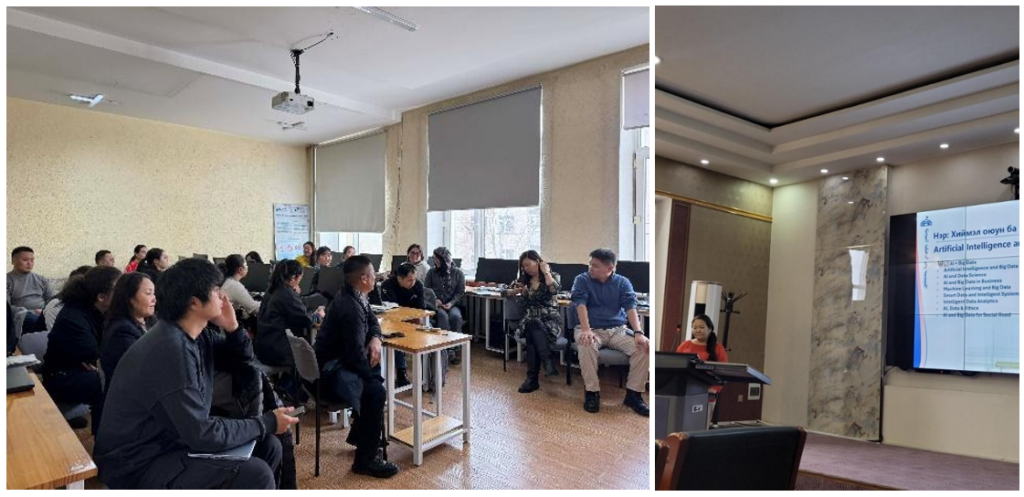
The National University of Mongolia (NUM) hosted an event focused on the implementation of Artificial Intelligence (AI) Bachelor’s and Master’s programmes and the new AI & Big Data course, advancing curriculum innovation in line with the Erasmus+ GreenTech Horizons project. The initiatives aim to strengthen institutional capacity, align higher education with labor market needs, and prepare students for the twin green and digital transition.
Modernizing curricula for a future-ready workforce
Within the framework of the GreenTech Horizons project, NUM has introduced a competency-based educational ecosystem integrating future green skills, digital skills, and business acumen. Key outcomes highlighted during the event include:
- Launch of AI Bachelor’s and Master’s programmes, with 43 new undergraduate students enrolled in 2025–2026 and projections reaching 200 by 2030.
- Admission of 11 Master’s students, expected to grow to 30 by 2027.
- Integration of the “Big Data and Data Science” course into NUM’s General Education Curriculum, with over 150 students participating in its first semester.
- Establishment of a dedicated AI training laboratory at the School of Information Technology and Electronics (SITE) to support hands-on learning and applied research.
These developments directly contribute to preparing a workforce capable of supporting sustainable economic growth and green digital innovation.
Engaging faculty and fostering continuous improvement
The event brought together curriculum developers, academic staff, administrative teams, and department-level programme committee members. Participants provided positive feedback on the practical implementation, relevance to labor market needs, and sustainability-oriented digital competencies of the programmes. Highlights included:
- Effective integration of theoretical knowledge, practical applications, and green digital skills.
- Emphasis on iterative improvements through regular coordination meetings, academic discussions, and collaborative planning.
- Recognition of the need for ongoing capacity building in applied AI, big data analytics, and modern teaching tools to ensure long-term programme quality.
Broad dissemination and institutional impact
The launch of AI programmes and courses was widely communicated through institutional channels, academic networks, and public platforms, generating strong interest among students. Additional activities included:
- University-wide promotion of the Big Data and Artificial Intelligence course.
- Targeted sessions for Master’s students on aligning research and projects with green and digital priorities.
- Continuous engagement of faculty and administrative units to ensure effective delivery and sustainability of the programmes.
These efforts enhanced the visibility and impact of GreenTech Horizons at NUM, demonstrating a concrete institutional contribution to the dual green and digital transition in higher education.